


Car insurance Namibia
4×4 Car rental Namibia
CHOOSE YOUR
TYPE OF
CAR INSURANCE
In Namibia and many other African states, you are not obliged to insure your rental vehicle. This is different to the European standards where car insurances are required by European policies. European insurances such as “Full Casco” or “All Risk” are simply not known nor commonly applied in Namibia.
With some travel insurances it is possible to insure damage to the vehicle which are not covered by the car insurance of the rental company. Some credit card companies also cover possible damages. We strongly recommend that you inform yourself well and in advance about the different insurance policies and options.
BACKGROUND
It is important to be aware of and understand that there are significant differences in Southern Africa compared to Europe, when it comes to car insurances and responsibility in case of damages.
For example, in Namibia and Botswana, it is not obligatory to have any car insurance. In practice this means that the majority of cars are not insured at all and that the owners and/or car users are responsible for any damages and related compensation in case of an accident or damages. All renters/drivers should be at least 25 years old and be in possession of the driver’s license for at least 2 years.
When renting a vehicle with a reduced excess, additional fees will be charged.
STANDARD EXCESS
In addition to the general exclusions, glass damage and tyre damage are not covered under the standard excess and remain at the renter’s expense.
REDUCTION OF THE EXCESS
All rental vehicles carry third-party insurance and are insured for damage to the rental vehicle itself in the event of a traffic accident. A chosen excess always applies, which is payable by the renter. The renter has the option to (partially) waive the excess by paying an additional daily fee. The exact amounts vary by rental company and by type of vehicle.
The standard excess is generally N$ 40,000. A typical example of the available waiver options is:
Reduction 1: excess N$ 20,000
Reduction 2: excess N$ 5,000
Super Cover: excess N$ 0
The chosen excess serves as a security deposit and is blocked by the rental company on the credit card(s) of the main booker upon collection of the vehicle. Most companies accept VISA or Mastercard, and the deposit may be spread across multiple cards provided all cards are in the main booker’s name. The block is released automatically once the vehicle is returned without damage.
Important: The coverage described applies to damage to the rental vehicle itself. If a replacement vehicle is required following an accident, this is considered a new rental agreement, and the rental and delivery costs are payable by the renter (also in the case of Super Cover).
REDUCTION 1 AND 2
Reduced excess amounts help in case of an accident, especially when a third party is involved. All damage to the rented vehicle as well as third party damage, above the value of the choses excess, is covered. Important: Reduction 1 and 2 exclude cover of damage to tyres and windows; and excludes cover of damages as a result of single vehicle accidents and/or sandstorms.
Section
Empty section. Edit page to add content here.
SUPER COVER
With a full waiver of the excess, the remaining excess is reduced to N$ 0. This means that, in principle, the renter does not owe any excess in the event of damage to the rental vehicle or to a third party’s vehicle.
A full waiver also provides coverage for damages that are excluded under a partial waiver, such as:
- Windscreen damage
- Damage to one (1) tyre/rim
- Damage from single-vehicle accidents
- Undercarriage damage (excluding damage resulting from off-road driving in areas such as the Kaokoveld and Damaraland)
Damages as a result of negligence, such as speeding, driving under the influence of alcohol, etc. are never covered.
Please note: Super Cover is in no way comparable to the European “Fully Comprehensive” or “All Risk” insurance, under which all damage is always covered regardless of the cause or the question of fault. This kind of policy simply does not exist in Namibia and Botswana. Even with a full waiver, certain general exclusions still apply, such as damage caused by gross negligence, driving under the influence, off-road driving, or any breach of the rental terms and conditions. The exact terms and exclusions vary per car rental company.
SINGLE VEHICLE ACCIDENT
Any accident not involving a third party are considered single vehicle accidents. Losing control over the vehicle and subsequently rolling the car over, or bumping a tree while reversing the car are examples of single vehicle accidents.
TRAFFIC ACCIDENT
The applied definition of a traffic accident is: an accident with the vehicle where another vehicle, person/pedestrian or animal is involved.
Important: accidents without involvement of other parties, e.g. rolling the car as a result of losing control – even when trying to e.g. avoid hitting an animal crossing the road, is not covered with Reduction 1 or 2.
NEGLIGENCE
Negligence, for this purpose, means a failure to act correct legally or failure to adhere to general regulations and practices. Insurances companies will not cover any damages as a result of, for example:
- driving under the influence of alcohol/other sense altering substances
- speeding
- crossing a red traffic light
- driving through water (rivers, swamp, sea), where the water level is higher than the axel of the car
- abuse of or incorrect use of clutch, gears and engine of the car
- other forms of negligence
EXCLUSIONS
Damages with are not covered by the insurance company:
- (Burning) damage caused by cigarettes, matches and/or lighters
- Damage caused by walking or standing on the roof or bonnet of the car
- Damage caused by rolling the car without the involvement of another party (covered in Reduction 3)
- Damaged glass and windows (covered only in Reduction 3)
- Damaged tyres (punctures, leaking, and/or extraordinary use) (1 tyre, covered only in Reduction 3);
- Damage caused by driving through water
- Damage cause by sandstorms
- Damage to personal belongings
- Damage to clutch and gearbox due to abuse or incorrect use
- Damage resulting from off-road driving
EXCLUSIONS ON 24-HOUR BACKUP SERVICE AND REDUCED EXCESS
In certain areas, the offered 24-hour backup service is not valid. These areas are often more difficult to reach and as renters chose to stray from the main roads, towing costs are on the renter’s account. Of course, assistance will be sent as soon as possible, but it may take some more time than usually.
These specific areas are: Kaokoland and Bushmanland in Namibia, all parks and surrounding areas in Botswana, whole of Zimbabwe, Zambia, Mozambique and Malawi. Reduced excess cannot be applied for drives through Zimbabwe, Zambia, Mozambique and Malawi. The days spent in (one of) these countries are also not charged for when reduced excess is applied, e.g. for days spent in Namibia and/or Botswana. The reduced excess charge will be refunded once proof is submitted, by means of showing stamps in passport, upon returning the car.
THEFT
In case the vehicle gets stolen, only the excess value of the car is retained. Costs above the excess are covered by the insurance as long as negligence can be excluded, the vehicle was locked and the client can present the original car keys.
TYRE DAMAGE
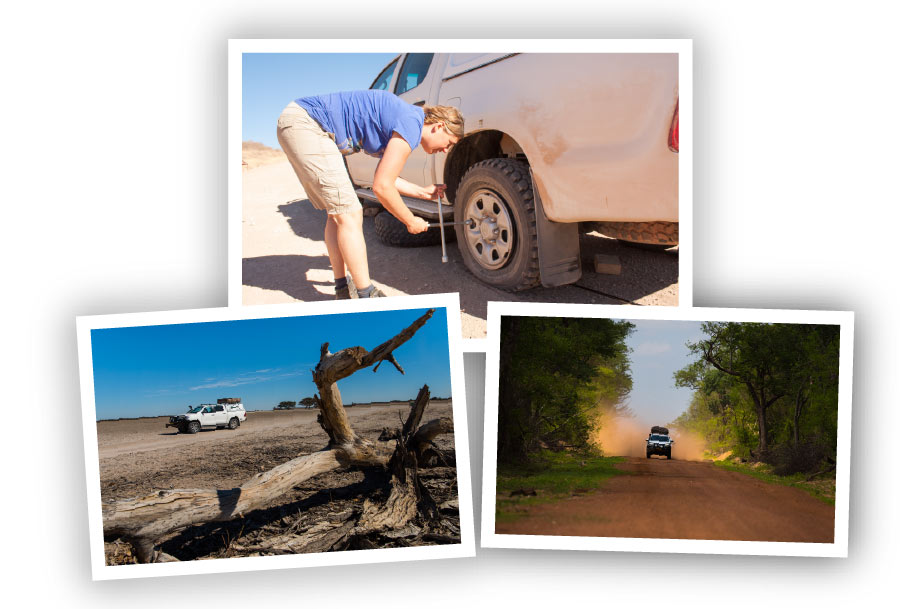
The minimum profile of the tyres is 6 mm (3 mm for spare tyres). Tyre damage is not covered (1 tyre only with reduction 3). Punctured or otherwise damaged tyres can either be fixed or replaced with a new one. The cost of the damaged tyre will be determined by its profile depth, and a replaced tyre’s costs will also be taken into account when calculation total damage costs.
SANDSTORM
In case of a sandstorm, stop the car immediately and try to look for a temporary shelter. If this is not at all possible, then continue driving at very low speed. Damages caused by a sandstorm are not covered by the insurance. Sandstorms mostly occur at the coast and in case of east wind.
POLICE REPORT
It is compulsory to obtain a full police report in order to claim any damages from the insurance. And it is always advisable to take pictures if possible.
Towing costs
Towing cost related to any form of accident is always on the renter’s account.
‘CLAIM HANDLING’ FEE
The administrative costs related to an insurance claim or any damages, called ‘claim handling fees’, are to the renter’s account.
COVERAGE BY ‘OWN’ INSURANCE
With some (travel) insurance companies, it is possible to get additional insurance for damages to rental vehicles, which are not covered by the standard insurance of the car hire company. Also, some credit card companies offer these additional insurances. We advise you to inform yourself and organize this in advance should you want to make use of these.
MORE INFORMATION
For more information, please also read through the insurance policy as well as the terms and conditions supplied by the car rental company.
* Important: refer to the definition of traffic accidents, which is dealt with by the insurance company, also considering negligence and the exclusions.
Book your 4×4 rental car together with stunning accommodations and travel at your own pace.
We will gladly assist you with a tour through Namibia, Botswana, Zimbabwe, South Africa, Malawi, Zambia, or Mozambique.
We will gladly assist you with a tour through Namibia, Botswana, Zimbabwe, South Africa, Malawi, Zambia, or Mozambique.
